
How to Read an Authentic Lab Report & How much should we pay for it
When sourcing wholesale facial gua sha tools, authenticity is everything. If you are importing genuine rose quartz gua sha or aventuriene jade gua sha, a professional gemological certificate is your shield against counterfeits.
However, many beauty brands and buyers get confused when they look at an official gemstone report (such as those from leading Chinese labs or GIA). They wonder: “Why doesn’t it say ‘Natural Rose Quartz’ directly?” or “What do these scientific terms mean?”
In this guide, we will break down exactly how to read a professional jade gua sha certificate, helping you spot the difference between real mineral tools and cheap glass or plastic imitations.
7 Core Elements of an Authentic Gua Sha Gemstone Certificate
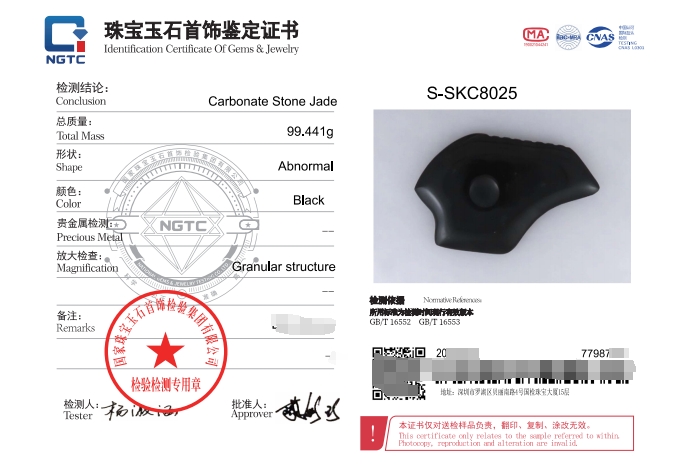
1. Scientific Identification Result (Mineralogical Names)
An authentic lab certificate will almost never directly output commercial names like “Natural Rose Quartz” or “Aventurine Jade” in the primary result field. Instead, it uses the official mineralogical and chemical composition name.
- For Rose Quartz, it will state “Quartz” (石英) or “Quartzite” (石英岩).
- For Aventurine, it will also state “Quartzite” due to its mineral structure.
- The “Popular Name” Exception: To help buyers, professional labs will typically list the trade names (like Rose Quartz or Aventurine) in the “Remarks” (备注) section.
- The “Natural” (天然) Keyword Rule: In standardized gemology (including GIA and leading Asian labs), the word “Natural” is strictly reserved for organic gems or specific elements. For instance, only Natural Pearl (天然珍珠) and Natural Glass (like Obsidian/黑曜石) will explicitly state “Natural” in the main result.
2. Precise Total Mass (Weight)
A legitimate certificate will always measure the total mass of the specific gua sha tool using ultra-precise gemological scales. The weight is always recorded to two decimal places in grams (e.g., 75.42g). Because every hand-carved stone varies slightly, if you buy 100pcs, each certificate must show a slightly different weight.
3. Regulatory Certification & Verification Codes (MA Logo)
In China, where the majority of high-quality gemstone processing takes place, a valid certificate must bear the CMA (China Inspection Body and Laboratory Mandated Approval) or CNAS logo. Right beneath or beside the MA stamp, there must be a unique tracking and verification code specific to that testing agency.
4. Objective Color Grading (No “Natural Color” Phrasing)
The certificate will document the exact visual color of the facial gua sha (e.g., Pink, Light Green, Black). However, professional labs report only what they see; they will never write “Natural Color” (天然色) on the certificate. They simply state the color name objectively.
5. Magnification Examination & Fibrous Structure
Under a microscope, natural stones reveal their internal birthmarks. The certificate will feature a “Magnification Examination” (放大检查) section. For authentic jade and quartz-based tools, the structure is almost always described as a “Fibrous Structure” (纤维结构) or “Granular Epitaxial Structure”. If a tool shows air bubbles instead of a fibrous crystalline matrix, it is fake glass.
6. Scannable QR Code for Instant Verification
Modern authentic certificates come with an anti-counterfeiting scannable QR code. When scanned with a smartphone, it must redirect you directly to the testing lab’s official secure database (not a cloned copycat site) showing the exact matching digital twin of your certificate.
7. Official Laboratory Credentials & Contact Information
At the bottom of the document, you will find the full name, official seal, website link, and telephone number of the authorized testing institution.
At a Glance: What Real Gua Sha Certificates Actually Say
To help your sourcing team, here is a quick reference table showing commercial names versus official laboratory terminology:
| Commercial Skin Care Name | Primary Certificate Result | Where to Find the Common Name | Will it say “Natural”? |
| Rose Quartz Gua Sha | Quartzite / Quartz (石英岩/石英) | Listed in “Remarks” | No |
| Aventurine Gua Sha | Quartzite (石英岩) | Listed in “Remarks” | No |
| Obsidian Gua Sha | Natural Glass (天然玻璃) | Primary Result | Yes |
| Fake Glass/Resin Tool | Glass / Plastic (玻璃/塑料) | N/A (Fails Authentic Testing) | No |
The cost of the GIA certification
In China, accoridng the GIA certification lab, the quote around $50-$150 for a certification. Also to the products we guarantee it’s natural materials, if you test in your country fake 1pcs find, we guarantee 10pcs equal cost refunded.
Frequently Asked Questions (FAQ)
Why doesn’t a GIA or CMA certificate explicitly label my Rose Quartz as “Natural”?
In professional international gemology standards (like GIA), minerals are classified by their scientific species and groups. Since “Quartz” inherently implies a natural mineral origin unless specified as “Synthetic,” labs do not redundantly add the prefix “Natural.” They rely on mineralogical terms rather than retail marketing vocabulary.
How can I verify if my wholesale Gua Sha certificates are real?
Always cross-check the precise total mass (down to 0.01g) shown on the paper with a digital scale. Then, scan the QR code and verify that the URL matches the official governmental domain of the listed testing laboratory.
Why not all your products have a GIA certification?
Because we know some products used same materials, and do GIA certification every shape need do one test, to save the cost we do not send all of our products to the lab to finish the GIA cerfication. Around 60% percent of our rose quartz gua sha have a test.
Partner with a Transparent Manufacturer
At Perfect Craft, we believe in absolute transparency. Every batch of our facial gua sha tools—whether crafted from premium 304 stainless steel or authentic natural minerals—undergoes rigorous quality control. We provide fully traceable, verifiable gemological certificates to ensure your brand’s reputation remains flawless.
Contact us today to get authentic samples for your skincare line!